
A Christmas tale
reading Sir Gawain and the Green Knight

I interrupt the Richard the Lionheart castle series to share a Christmas story with you, a book I am reading. You may know the tale. It is called Sir Gawain and the Green Knight. It is a Christmas tale, believe it or not.
This king lay at Camelot at Christmas-tide
with many a lovely lord, lieges most noble,
indeed of the Table Round all those tried brethren,
amid merriment unmatched and mirth without care.
So, imagine yourself (or place yourself) in a comfortable chair, the snow lightly falling outside, the sun long since set, and (if you celebrate Christmas), the lights on the Christmas tree blinking, a Christmas drink in your hand, perhaps an eggnog. For a brief hour, you disappear into another world. A world of heroic knights, fair ladies, the Round Table, and a Christmas celebration.

A giant horseman rides into the hall, seven feet tall, with green skin and a giant, nasty-looking axe in his hand. He challenges the room to a battle: “You may strike me once with the axe, any way you choose. In a year and a day, I return the favor.”
The room is stunned, and afraid. The world of Faerie has entered to their celebration. Arthur volunteers for this Christmas game, but Gawain, a young knight and Arthur’s nephew, decides that the task is his. It is no spoiler to tell you that Gawain beheads the Green Knight, who proceeds to pick his head up, remind Gawain of his obligation to visit the Green Chapel in a year, and ride out, head in hand.
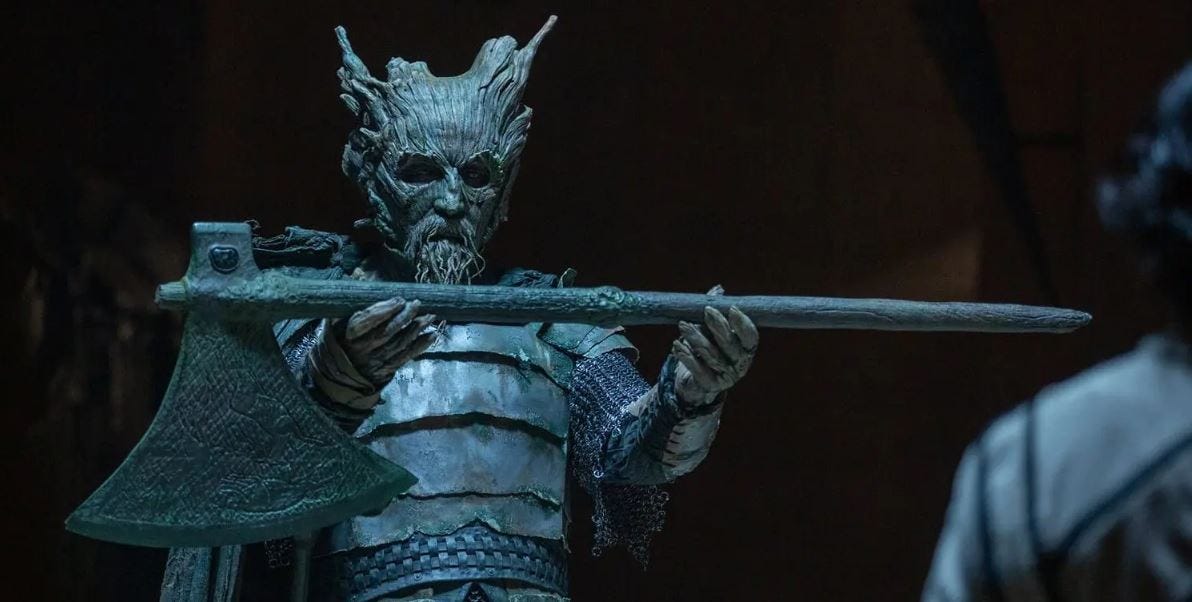
It sounds like a fantastical medieval story, but it is indeed a Christmas story. Arthur and the Round Table are celebrating Christmas at Camelot when the man appears. Gawain is given a year and a day, a traditional medieval ritual time span, to respond. The climax comes on New Year’s Day when Gawain arrives at the Green Chapel. It is also a morality tale: a tale of temptation, sin, and a moral reckoning.
The Green Knight is a later tale in the Arthurian canon, and it comes a few hundred years after Richard’s time. Chretien de Troyes’ famous Arthurian tales have long since been told. Those tales are steeped in the courtly ethos: chivalry, and the like. The Gawain poet (we do not know his name) is after something different. He is after Christian notions of sin and temptation. But he has hidden his exploration inside the trappings of a classical chivalric tale.
Sir Gawain and the Green Knight is written in a distinctive verse form. The poem made of long alliterative lines, each line divided by a caesura into two half-lines with stressed syllables bound together by alliteration rather than rhyme. At the end of each stanza, the poet concludes with a shorter, tighter, quatrain - four lines - summarizing the stanza it is in.
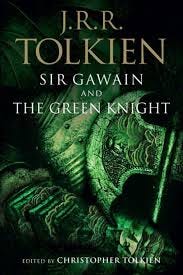
I am reading the Tolkien translation, as much because I love Tolkien as because it is necessarily the best translation (Simon Armitage’s translation is very well regarded). Tolkien leans in to the medieval/heroic verse form, a pounding rhythm. But strangely, as I read, the rhythm of “Twas the Night before Christmas” is what I hear.
Now of their service I will say nothing more,
for you are all well aware that no want would there be.
Another noise that was new drew near on a sudden,\
so that their lord might have leave at last to take food.
For hardly had the music but a moment ended,
and the first course in the court as was custom been served,
when there passed through the portals a perilous horseman,
the mightiest on middle-earth in measure of height,
from his gorge to his girdle so great and so square,
and his loins and his limbs so long and so huge,
that half a troll upon earth I trow that he was,
but the largest man alive at least I declare him;
and yet the seemliest for his size that could sit on a horse,
for though in back and in breast his body was grim,
both his paunch and his waist were properly slight,
and all his features followed his fashion so gay in mode;
for at the hue men gaped aghast
in his face and form that showed;
as a fay-man fell he passed,
and green all over glowed.All of green were they made, both garments and man:
a coat tight and close that clung to his sides;
a rich robe above it all arrayed within
with fur finely trimmed, shewing fair fringes
of handsome ermine gay, as his hood was also,
that was lifted from his locks and laid on his shoulders;
and trim hose tight-drawn of tincture alike
that clung to his calves; and clear spurs below
of bright gold on silk broideries banded most richly,
though unshod were his shanks, for shoeless he rode.
— J.R.R. Tolkien, Sir Gawain And The Green Knight, Pearl, And Sir Orfeo
Read the stanza beginning with “All of green were they made…” and tell me you do not hear A Visit from St. Nicholas (aka ‘Twas the Night before Christmas)!
The stump of a pipe he held tight in his teeth,
And the smoke, it encircled his head like a wreath;
He had a broad face and a little round belly
That shook when he laughed, like a bowl full of jelly.
He was chubby and plump, a right jolly old elf,
(and compare to the original:
Ande al grayþed in grene þis gome and his wedes:
A strayte cote ful streȝt, þat stek on his sides,
A meré mantile abof, mensked withinne
With pelure pured apert, þe pane ful clene
With blyþe blaunner ful bryȝt, and his hod boþe,
Þat watz laȝt fro his lokkez and layde on his schulderes;
The poem is not so long. If you are looking for a medieval Christmas read that will take you to another world, Gawain might be for you.
I wish you a peaceful holiday season and a new year filled with great reading.
