
Excalibur in China
Or, why isn't that blade rusty?

Sometime around the year 1190, the contemporary historian Gerald of Wales reports that King Arthur’s grave has been discovered at Glastonbury. He says:
his [ed: Arthur’s] body was discovered at Glastonbury, in our own times, hidden very deep in the earth in an oak-hollow, between two stone pyramids that were erected long ago in that holy place. The tomb was sealed up with astonishing tokens, like some sort of miracle.
Roger of Hoveden, another historian of the era who was personally with Richard the Lionheart on crusade, reports that Richard gifts Excalibur (or “Caliburn, the sword of Arthur”, as Roger calls it) to Tancred, the usurper king of Sicily, during negotiations over Sicily and supplies for Richard’s crusade to the holy land. Roger is silent on the matter of how Richard obtained this miraculous sword, and devotes a single sentence (the only sentence in recorded history) to the entire fantastical subject. Frustrating for history. I wrote more on the history of Excalibur here, for the curious.
In my as-yet-unpublished novel of the Third Crusade, Excalibur is discovered buried along with Arthur. Neither Gerald of Wales nor any other historian mentions this, but it seems a very natural extrapolation to me. What is not natural in my story is that Excalibur is not a normal blade. It is discovered brightly shining and as sharp as the day it was forged, though it has been in the grave for 700 years. This is the first, though not last, evidence the sword is not a normal blade.
So imagine my surprise to learn a few days ago that this precise situation has occurred in actual history.
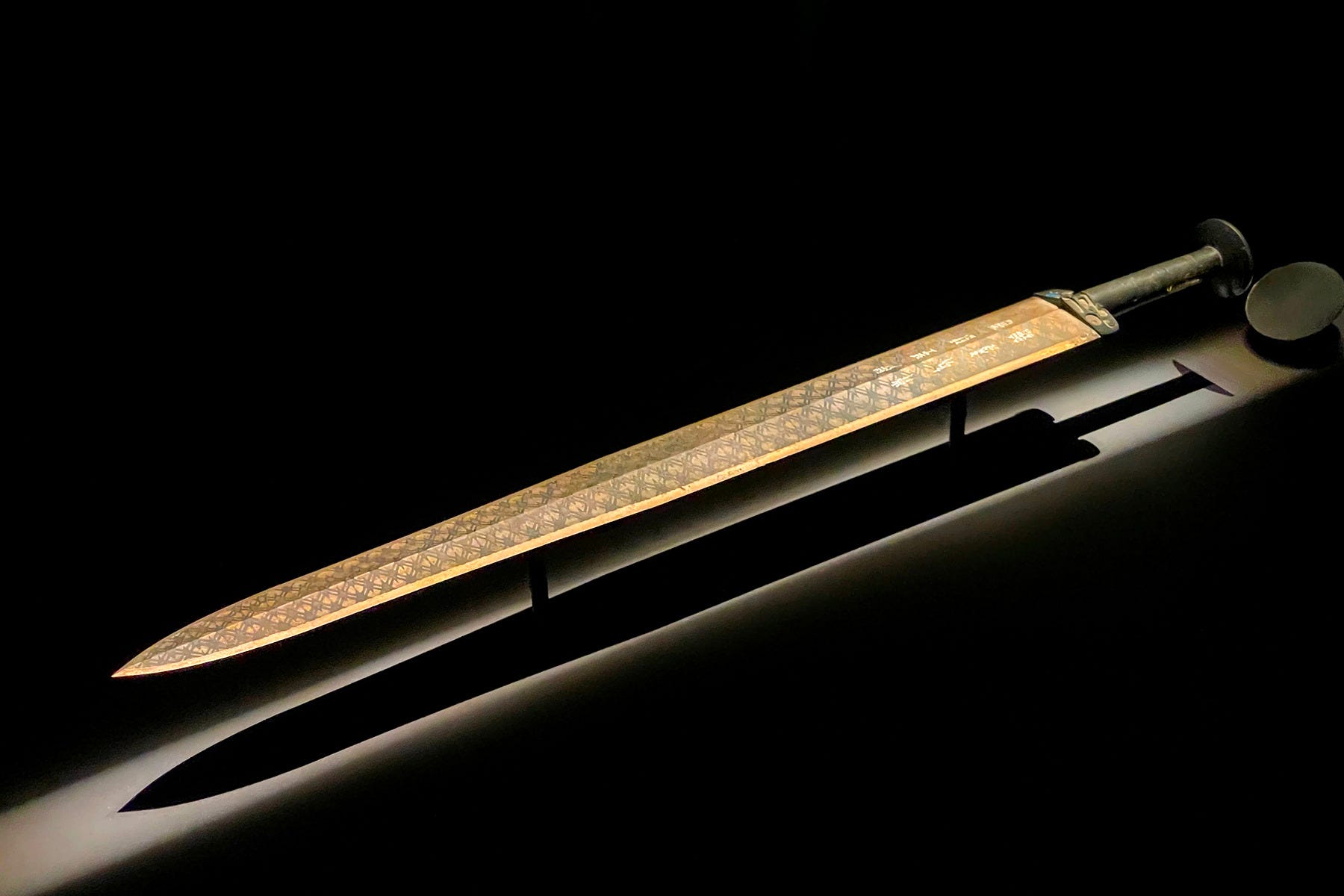
Only, the sword was not Excalibur and the location was not England.
It’s 1965, and archaeologists in China are performing a survey along an aqueduct in Hubei, deep in the heart of China. A series of tombs is discovered, leading to a large dig. In a casket, alongside a skeleton, inside a wooden scabbard, researchers discover The Sword of Goujian. Inscriptions on the blade say it is the sword Goujian, a king of the Yue state who reigned 496-465 BCE, so the sword had been in the ground for nearly two thousand years.
The sword is completely untarnished, the blade still sharp as the day it was forged, made from an alloy of copper and tin, a beautiful Bronze-age sword. “I am not making this up,” as the writer Dave Barry is wont to say.
Sometimes truth is stranger than fiction, no?

The Goujian parallel is perfect. Worth noting that the preservation isn't magic. The bronze alloy combined with the nearly airtight lacquered scabbard and anaerobic conditions in the tomb essentially prevented oxidation. Which is arguably more interesting than magic, because it means someone in the Yue state 2,500 years ago understood material science well enough to build a sword that could survive burial. The real Excalibur connection is the mythological instinct both cultures share: that a great king's blade should outlast him. The sword as proof that sovereignty doesn't rot. There's something deeply human about that. The refusal to accept that the best things a civilization produces should be as mortal as the people who made them.